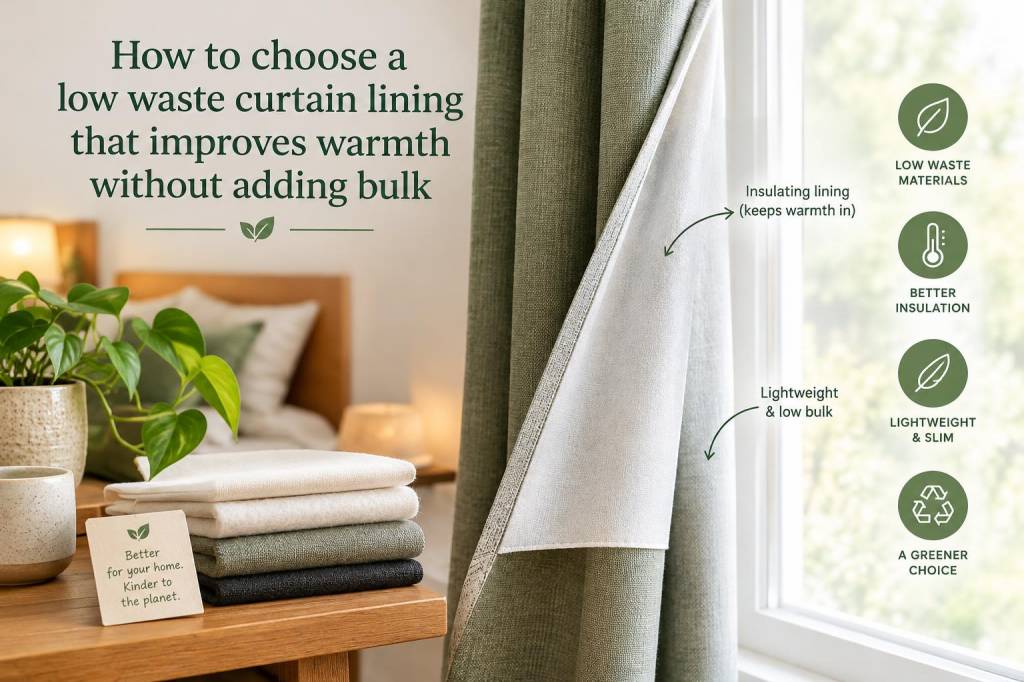
When I started paying closer attention to comfort at home, I realised curtains do far more than soften a room. A good curtain lining can hold warmth, reduce draughts, improve drape, and help fabric last longer. A poor one can make curtains feel stiff, heavy, and fussy. For me, choosing a low-waste lining has become one of those small decisions that quietly improves a space without creating unnecessary clutter or excess material.
I look for linings the same way I look for most home materials now: I want something that serves a clear purpose, uses as few resources as possible, and feels practical in everyday life. If a lining is meant to improve insulation, I want it to do that without adding visible bulk or making the curtains harder to hang. If it is meant to protect the face fabric, I want it to do so without introducing synthetic waste I will regret later.
What I want a curtain lining to do
Before I buy anything, I ask a simple question: what job should this lining actually do? In my home, that answer is usually a combination of warmth, light control, and fabric protection. I do not want to overbuild a curtain system if a lighter lining can achieve the same comfort with less material.
A lining can help in several ways:
- Insulation: it creates an extra air layer that slows heat loss.
- Drape: it helps curtains hang neatly and move more smoothly.
- Protection: it shields the face fabric from sun damage and dust.
- Privacy: it reduces transparency, especially with lighter woven fabrics.
If warmth is my main goal, I do not automatically reach for the thickest possible backing. Bulk can make curtains look heavy and reduce the soft folds I love. I prefer a lining that supports insulation through structure and smart fibre choice rather than sheer thickness.
Fabrics I trust for a lower-waste choice
My first instinct is usually to look for natural fibres or recycled options, because they tend to feel more aligned with low-waste decorating. That does not mean every synthetic lining is wrong, but I try to be thoughtful about what enters my home.
Here are the options I reach for most often:
- Unbleached cotton: breathable, easy to sew, and usually a good all-round choice for lighter insulation.
- Organic cotton: similar to standard cotton, but often gentler in sourcing and production.
- Wool felt or wool blend: excellent for warmth, though it can be heavier and more expensive.
- Recycled polyester lining: useful when durability and washability matter, especially in busy rooms.
- Thermal cotton blends: often a balanced middle ground when I want insulation without a dense, padded feel.
If I am choosing between a thick synthetic thermal backing and a lighter natural lining, I usually start with the natural option and only move to a more technical material if the room truly needs stronger heat retention. In many homes, a well-fitted curtain with a decent lining is enough to make a noticeable difference.
Why thickness is not always a sign of better warmth
I used to assume that more thickness always meant more insulation. Experience has changed that. A lining that is too bulky can trap fabric awkwardly, create bulky hems, and make curtains hang away from the window in a way that looks tidy on a sample but awkward in real life. Worse, it can make the curtains harder to close fully, which reduces their practical value.
Warmth comes from more than material weight. A lining works best when it helps reduce air movement near the window. That means fit matters just as much as fabric. Curtains that are the right width, long enough to reach the floor or sill properly, and positioned close to the wall will perform better than oversized, overstuffed panels.
I also find that a lightly brushed or closely woven lining can outperform a thicker one if the curtain is otherwise well made. A dense weave, careful hems, and proper fullness often matter more than extra padding.
What I check before buying
When I shop for curtain lining, I like to read beyond the product name. Labels can sound reassuring while hiding a mix of fibres or finishes that are less useful than they appear. I look for a few practical details before deciding.
| What I check | Why it matters | What I prefer |
|---|---|---|
| Fibre content | Shows whether it is natural, recycled, or mixed | Organic cotton, unbleached cotton, recycled polyester, or wool blend |
| Fabric weight | Helps predict bulk and drape | Light to medium weight for most rooms |
| Finish | Can affect feel, breathability, and appearance | Simple, undyed, or lightly finished fabrics |
| Washability | Important for long-term use and maintenance | Machine washable when possible |
| Width and length | Helps reduce offcuts and waste | Sizes that match the curtain panel with minimal trimming |
That last point matters more than people expect. If I can buy a lining width that reduces cutting waste, I will. I also like to plan curtain projects so that any leftover fabric can become cushion covers, tiebacks, or small repair patches later.
When I choose thermal lining and when I do not
I use thermal lining selectively. It is useful in rooms that feel cold, especially near older windows or in spaces that lose heat quickly. But I do not use it automatically in every room, because thermal fabrics can sometimes make curtains feel stiff or too formal for the relaxed atmosphere I like.
I am more likely to choose thermal lining when:
- the room faces a cold side of the house
- the window is single glazed
- the curtains are used every day and need stronger comfort support
- the room is a bedroom or sitting room where warmth matters most
I am less likely to choose it when:
- the room already feels well insulated
- I want a very soft, floaty curtain movement
- I am working with delicate fabric that would hang badly under extra weight
- I only need privacy, not heat control
In some cases, I prefer a layered approach instead of one heavy lining. A simple lining plus a well-fitted curtain can work beautifully. If I still need more warmth, I may add a discreet inner blind or draught reduction around the window frame rather than forcing the curtain to do all the work.
Low-waste details that make a real difference
The most sustainable choice is rarely the one that looks most impressive in a product description. It is the one that stays useful for years. I try to make curtain linings work harder by paying attention to the small details that reduce waste over time.
- Use what already fits: if an old lining can be repaired or reused, I keep it.
- Choose neutral colours: natural, undyed, or soft neutral linings are easier to reuse later.
- Buy once, measure well: careful measuring avoids surplus cuts and returns.
- Prioritise repairability: simple fabrics are easier to mend than heavily coated ones.
- Wash gently: longer life always means less replacement waste.
I have also learned to think about lining as part of the whole curtain system rather than a separate product. If the face fabric is already thick, the lining can usually stay lighter. If the face fabric is sheer or loosely woven, a modestly stronger lining may be enough. Matching the lining to the curtain fabric prevents over-specifying everything.
Small sewing choices that improve warmth without extra bulk
Even a good lining can underperform if it is sewn carelessly. I like to keep construction simple and neat. My goal is to avoid piling on layers while still creating a curtain that feels substantial.
These are the details I pay attention to:
- I attach the lining with enough ease so the curtain moves naturally, not tightly.
- I keep hems balanced, because uneven hems can twist the fabric and create gaps.
- I avoid overly thick interfacings unless the curtain truly needs structure.
- I let the lining finish slightly shorter than the face fabric when I want a softer visual edge.
- I press carefully, because good pressing improves drape more than many people realise.
When I sew at home, I often test a small section first. A lining that feels excellent in my hands may still behave differently once it is full length. A test piece helps me see whether the curtain will hang softly or feel boxy. That little step has saved me from several disappointing projects.
Balancing comfort, cost, and responsibility
I do not think low-waste decorating has to mean perfection or expensive specialist materials. Sometimes the most responsible choice is the one that uses less, lasts longer, and solves the problem simply. For curtain lining, that often means choosing a fabric that is durable, breathable, and suitably warm without becoming over-engineered.
If I am trying to keep costs sensible, I compare three things at once: material quality, expected lifespan, and how much warmth the room really needs. A moderately priced lining that performs well for years is a much better use of money than a high-end option that is too heavy, too fragile, or too specific for the space.
I also like to think about seasonal use. In a mild room, a lighter lining can be enough all year. In colder months, I may add a removable layer near the window rather than replace the curtain entirely. That flexibility keeps waste low and makes the room easier to adapt as the weather changes.
Sometimes the simplest answer is the one I return to most often: choose a lining that does one job well, avoid unnecessary thickness, and let the curtain itself do the rest. When I get that balance right, the room feels warmer, softer, and calmer without looking overbuilt or overdecorated.