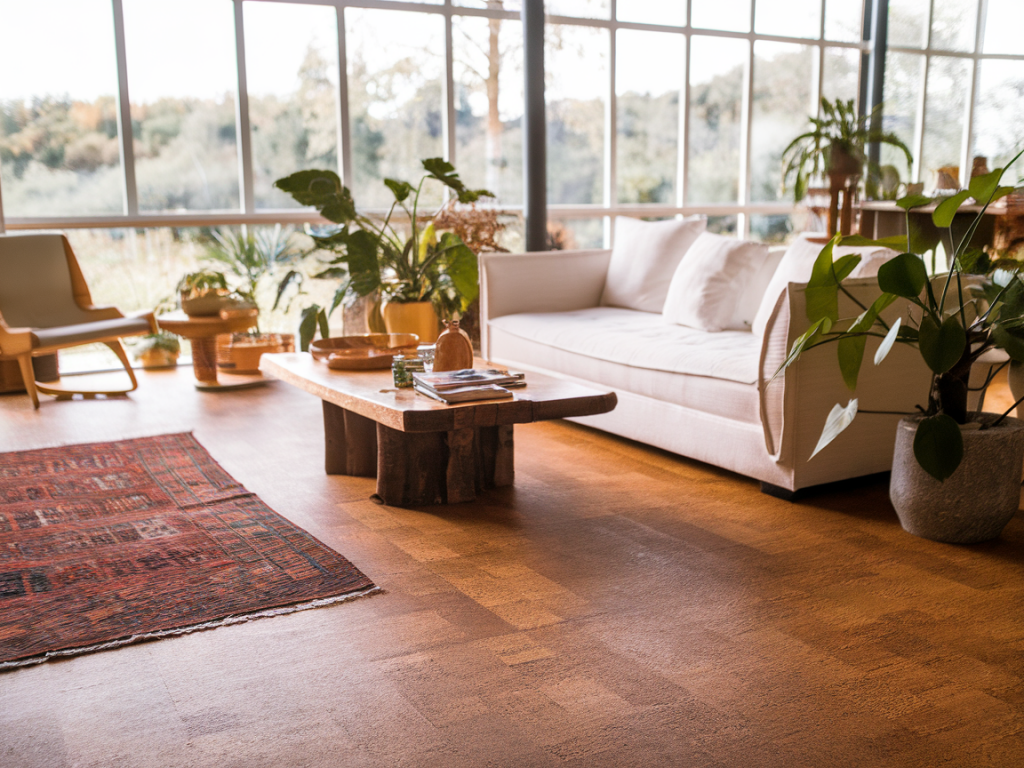
I’ve long loved cork for its warm, tactile feel and the way it absorbs sound and light — it has that comforting, lived-in quality I aim for in a home. But as someone who writes about sustainable decorating and tests everything I recommend, I wanted to take a closer look: is cork flooring truly a sustainable choice? Below I share what I’ve learned from research, supplier conversations, and my own hands-on tests, plus a practical checklist you can use when choosing cork for a real home (especially if you’re thinking about durability, adhesives, or underfloor heating).
Why cork feels like a sustainable option
Cork comes from the bark of the cork oak (Quercus suber). The important ecological detail is that the bark is stripped by hand every 9–12 years without cutting down the tree — a process that allows the tree to keep growing and absorbing CO2. That makes cork a rapidly renewable material compared with most timber options, and cork oak landscapes (montados) support biodiversity in countries like Portugal and Spain.
That said, “renewable” doesn’t automatically mean “sustainable.” There are nuances around how the cork is harvested, processed, finished, and transported — each step affects the overall environmental footprint.
Key sustainability factors to check
- Harvesting practices: Look for suppliers that source cork from managed cork oak woodlands where traditional manual stripping is used and where local communities benefit economically.
- Certifications: FSC certification is helpful — it confirms responsible forest (and cork woodland) management. Some brands will also share details of provenance and social programs.
- Processing and waste: How much energy is used in pressing and manufacturing? Do they reuse leftover cork granules? Cork can be produced with relatively low waste when manufacturers recycle granules into underlay or insulation.
- Finishes and adhesives: The varnishes, sealants, and glues used can negate some sustainability wins if they release high VOCs or contain petrochemical binders.
- Longevity and reparability: A long-lasting floor that can be sanded or locally repaired is often more sustainable than a short-lived product.
- Transport and local sourcing: Cork often originates in southern Europe; choosing brands that manufacture locally to you or that offset transport impacts helps reduce carbon footprint.
Durability: what to expect and what to ask
Cork floors vary widely in durability. There are full-thickness cork planks, cork tiles with wear layers, and engineered cork flooring bonded to a plywood base. Here’s what I learned and tested in my own flat:
- Wear layer matters: Look for a robust polyurethane or hard-wax oil finish. Commercial-grade PU finishes outperform lighter sealants in heavy-traffic zones. I found that a 6–8 coat water-based PU finish gives a resilient surface while keeping VOC emissions lower than older solvent-based options.
- Thickness: Thicker cork means better resilience and comfort underfoot. A 6–10mm cork layer over a plywood or HDF base is common; thicker options (10–20mm solid cork) are available for specific uses.
- Scratch and dent resistance: Cork is soft compared with oak or tile, so it can dent under heavy furniture. Use felt pads under legs and a protective mat for heavy appliances. I’ve had success blending cork’s softness with rugs in high-wear walkways.
- Refinishing: Some solid cork floors can be lightly sanded and re-coated; engineered cork has more limited refinishing ability. Ask the manufacturer about repairability before buying.
Glue and adhesives: what’s safe and effective?
Adhesives are a make-or-break sustainability detail. Many cork floors are glued down, which raises two concerns: the long-term stability of the bond and the potential for harmful VOCs.
- Choose low-VOC or water-based adhesives: Brands such as MAPEI and Bostik offer low-VOC, low-odour adhesives rated for cork. Always check for EMICODE EC1 or similar low-emission labels.
- Compatibility with cork and subfloor: Some adhesives are formulated for flexible cork; others for rigid planks. Confirm with the manufacturer which adhesives they recommend for your specific product.
- Moisture barriers and damp subfloors: If you’re on a ground floor or concrete slab, you’ll need a damp-proof membrane. Some adhesives include moisture resistance properties, but often a separate DPM layer is required.
- Removability and end-of-life impacts: Fully glued installations can be harder to remove and recycle. If future reuse is a priority, consider floating cork systems (click-lock) that avoid full glue coverage.
Underfloor heating and cork: yes, but with limits
Cork is naturally insulating (a benefit for warmth and energy use) but that also means it doesn’t conduct heat as efficiently as hard timber or tile. That doesn’t rule out underfloor heating (UFH) — it just means you need the right product and installation.
- Use cork products specified for UFH: Manufacturers will label cork flooring as compatible with underfloor heating. These products are typically engineered to allow heat transfer while accommodating thermal expansion.
- Maximum surface temperature: Cork undersurfaces should not exceed about 27–29°C (80–84°F) at the top surface — check the product specs. This prevents drying and cracking of the cork and finishes.
- System type matters: Water-based (hydronic) systems are commonly paired with cork. Electric mat systems are possible but need careful control and manufacturer approval.
- Installation guidance: Leave appropriate expansion gaps, use an adhesive or floating system approved for UFH, and ensure your heating is gradually ramped up after installation to avoid thermal shock.
- Thermal performance: Cork will add some insulation — that can slightly reduce UFH efficiency, but the overall comfort (warm feet, steady surface temperature) is excellent.
Checklist: Buying cork flooring — a practical guide
| Question | What to check |
| Origin | Country of harvest and manufacturer; preference for Portugal/Spain origin with transparent supply chain |
| Certification | FSC or equivalent; details on social and biodiversity programs |
| Product type | Solid cork, engineered cork, or cork tiles — determine durability & refinishing options |
| Wear layer & finish | Water-based PU or hard-wax oil; number of coats; scratch rating |
| Adhesive | Manufacturer-recommended adhesive with EMICODE EC1 or low-VOC label; floating option available? |
| UFH compatibility | Manufacturer approval for underfloor heating; max surface temp; installation guidelines |
| Warranty & lifespan | Expected wear lifespan (years); warranty terms; may cover moisture or finish failures |
| End-of-life | Recyclability, take-back schemes, or local recycling options |
Brands, sourcing and my hands-on notes
I tested a few sample boards in my own living room and hallway. Brands I found reliable include Amorim (one of the largest cork producers) and Wicanders (quality engineered cork lines), plus some smaller European makers who share detailed sourcing info. I paid attention to:
- Smell and off-gassing: New cork should not have a strong chemical odour. Ventilate during and after installation — if you detect persistent solvent smells, ask the supplier for emissions data.
- Visual uniformity: Cork has natural variation; I prefer visible character rather than a too-perfect manufactured look. That said, watch for thin wear layers on cheaper tiles.
- Sample ordering: Always order larger samples to try in the actual room light and with your heating system if possible.
Maintenance and making cork last
Part of sustainability is making a choice last longer. Cork is easy to keep in good shape with a few simple steps I use regularly:
- Wipe spills quickly — cork is resilient but not fully waterproof. Use sealed finishes or sealed seams in kitchens.
- Use protective mats at entrances and under heavy furniture.
- Recoat finishes when traffic paths show wear rather than replacing boards.
- Avoid steam cleaners and harsh detergents; a damp mop with pH-neutral cleaner is best.
If you’re weighing cork against other floors (hardwood, laminate, LVT), think in terms of lifecycle: cork’s renewable harvest, long-lived performance with proper finish, and excellent acoustic and thermal properties all add up to a compelling sustainable case — provided you choose mindful sourcing and low-VOC installation systems. Use the checklist above when shopping, and don’t hesitate to ask suppliers for detailed environmental data and installation recommendations for UFH. I’ve found that a few extra questions up front often prevent bigger headaches later — and keeps your home both cozy and responsible.