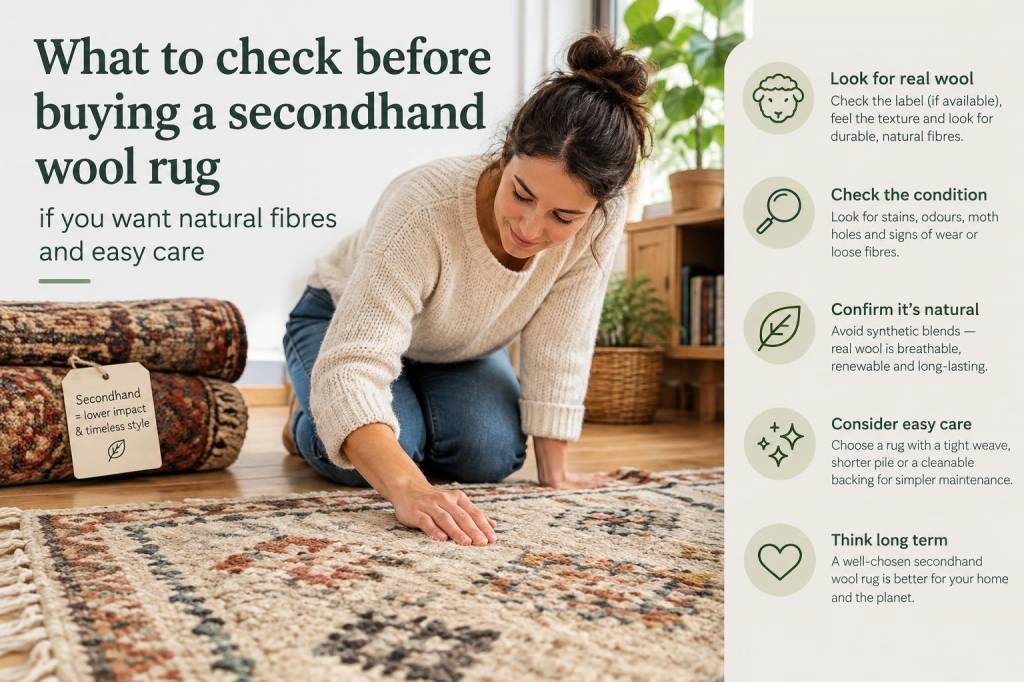
Buying a secondhand wool rug can feel like a small treasure hunt. I love that moment when a piece has already lived a life before it reaches my home: a little wear, a little history, a lot of texture. But if I am choosing wool for a space where I want natural fibres and easy care, I do not let the patina distract me from the practical details. A good secondhand rug should feel beautiful, but it should also suit the way I actually live.
When I shop for used wool rugs, I start by asking a simple question: Will this rug make my home easier to care for, or harder? That one question saves me from impulse buys that look charming in a listing photo but turn into constant maintenance once they land in a hallway, bedroom, or living room. Wool can be wonderfully forgiving, but not every wool rug is equally simple to live with. Construction, pile height, backing, stain history, and fibre blends all matter more than most people realise.
Start with fibre content and any hidden blends
My first check is always the fibre content. A seller may describe a rug as wool, but I want to know whether it is 100% wool or a blend with synthetic fibres. Blends are not always bad, but they change the feel, the care routine, and the long-term ageing of the rug. A small amount of synthetic backing or reinforcement is common and not necessarily a problem. What I try to avoid is a rug that is mostly synthetic but described in a vague way that makes it sound fully natural.
If I cannot inspect a rug in person, I ask for close-up photos of the back, edges, and any labels. The back often tells a more honest story than the front. A hand-knotted wool rug and a tufted rug with a latex backing behave very differently, even if they look similar in a listing. If I want natural fibres and easy care, I prefer rugs where the wool itself is doing most of the work, not a heavy synthetic layer hidden underneath.
Look closely at pile height and texture
The pile height matters more than I once expected. A very deep, shaggy wool rug can feel cosy underfoot, but it tends to hold dust, crumbs, and pet hair more readily. In a busy home, that means more vacuuming and a less relaxed cleaning routine. For easy care, I usually lean toward a low- to medium-pile wool rug. It still feels soft, but it is much easier to keep fresh.
Texture also changes how a rug behaves in real life. Flatwoven wool rugs are often easier to shake out, vacuum, and spot clean. Loop piles can be lovely and durable, but I check carefully for snags if I have pets or rough furniture legs. A cut pile may feel plusher, yet it can show wear patterns faster in high-traffic zones. When I am buying secondhand, I do not just ask whether I like the look; I ask whether I am willing to clean that texture for years.
Inspect wear in the places that matter most
Some wear is perfectly fine. In fact, I often like a little flattening in a rug because it gives a room softness without that brand-new stiffness that can feel too polished. What I do not want is structural damage. I check the centre, corners, edges, and any spots near furniture placement. Corners that curl, binding that frays, or threads that pull away can mean the rug will need repair sooner than expected.
I also look for uneven fading. Sunlight can give wool a lovely mellow tone, but strong fading in one section may point to a rug that was placed near a window for a long time. That is not always a deal breaker, especially if the rug will sit in a similar light pattern at home. Still, I want to know whether I am buying a gentle patina or a one-sided wear story.
Check for stains, smells, and moisture history
This is where I become very practical. Wool is naturally resilient, but old stains can be stubborn, and moisture damage is not something I want to bring indoors. I ask whether the rug has ever been stored in a damp cellar, used in a home with flooding, or cleaned with harsh chemicals that might have affected the fibres. A musty smell is a red flag for me, especially if the seller cannot explain it clearly.
Some stains are cosmetic, and some are permanent. If a rug has been professionally cleaned, I want to know what that means in real terms. Was it steam cleaned? Dry cleaned? Was any deodoriser used? I am not looking for perfection, but I do want honesty. A rug that is genuinely clean and structurally sound will always be easier to live with than a bargain that carries a hidden smell into every room.
Understand the backing and underside
The underside tells me a great deal about care and durability. If the rug has a latex backing, I check for cracking, flaking, or sticky patches. Older latex backings can break down over time, especially if the rug has been exposed to heat or moisture. That does not automatically mean I should avoid it, but it does mean I need to factor in future maintenance.
For a natural-fibre approach, I often prefer rugs with a simpler underside that will not shed crumbling material onto the floor. A rug pad can help either way, and I almost always plan for one. A good pad improves grip, protects floors, and reduces stress on the rug itself. It also makes the rug easier to vacuum because it stays in place instead of creeping around the room.
Ask where it will live in your home
I choose a secondhand wool rug differently depending on the room. For a bedroom, I can accept a little more delicacy because the traffic is lower and the cleaning demands are gentler. In a hallway or kitchen-adjacent space, I want something tougher, flatter, and easier to refresh. A living room rug sits somewhere between the two, depending on whether children, pets, and shoes are part of daily life.
Before I buy, I picture the rug in its future place and ask myself what the routine will be. Will it need frequent vacuuming? Will food and drink be near it? Will furniture legs sit on it? Will it be in direct sunlight? These questions help me separate a pretty rug from a practical one.
Use this quick checklist before paying
When I am standing in front of a secondhand rug, or messaging a seller online, I run through a short checklist in my head:
- Fibre content: Is it truly wool, or only partly wool?
- Construction: Is it hand-knotted, tufted, woven, or backed with latex?
- Pile height: Will it be easy to vacuum and keep clean?
- Wear: Are the edges, corners, and centre still sound?
- Odour: Does it smell clean, neutral, or damp?
- Stains: Are marks visible, and do they matter in its future room?
- Backing: Is there cracking, flaking, or hidden damage?
- Size: Will it fit the room without awkward gaps or overcrowding?
- Cleaning history: Has it been washed, dry cleaned, or exposed to moisture?
Know what easy care really means for wool
I think wool gets a reputation for being high maintenance when, in fact, it is often one of the easier natural fibres to live with. It resists dirt better than many fabrics, and it can recover well from everyday use. But easy care does not mean zero care. It means choosing a rug that fits your habits. For me, that usually means a wool rug with a manageable pile, solid structure, and no mystery odour.
Once the rug is home, my routine stays simple. I vacuum gently, rotate it every so often, and blot spills straight away with cool water and a clean cloth. I avoid scrubbing because that can drive dirt deeper into the fibres. If a rug needs more than spot care, I decide quickly whether I can handle it myself or whether a professional cleaner is worth it. I would rather spend a little more on proper cleaning than ruin a good natural rug with impatience.
Be selective about colours and patterns
Colour and pattern affect maintenance more than many people expect. Dark rugs can hide dust but may show lint. Very light rugs can make every mark feel dramatic, even when the stain is minor. Strong patterns are wonderful for disguising everyday wear, especially in shared spaces. If I want a rug to feel practical as well as beautiful, I often lean toward subtle marling, gentle variation, or a pattern that softens everyday mess without looking busy.
Secondhand rugs can be especially rewarding when the colour has mellowed naturally. I like those softer, slightly faded tones that come from age rather than artificial distressing. They usually feel easier to place in a room because they bring warmth without shouting for attention.
Trust your hands as much as your eyes
If I can touch the rug, I always do. My hands tell me whether the fibres feel brittle, oily, sticky, or pleasantly resilient. I press into the pile, lift a corner, and feel for firmness. A rug may photograph beautifully, but if it feels tired or uneven in person, I notice immediately. That tactile check is especially important with wool because the fibre should feel alive, not dry and fragile.
When everything lines up, a secondhand wool rug gives me exactly what I want: natural fibres, comfort underfoot, and a little history without a heavy footprint. I like knowing that I have chosen something already made, already tested by time, and still ready for another home. The right rug does not just decorate a room; it earns its place by making daily life feel calmer, softer, and easier to maintain.