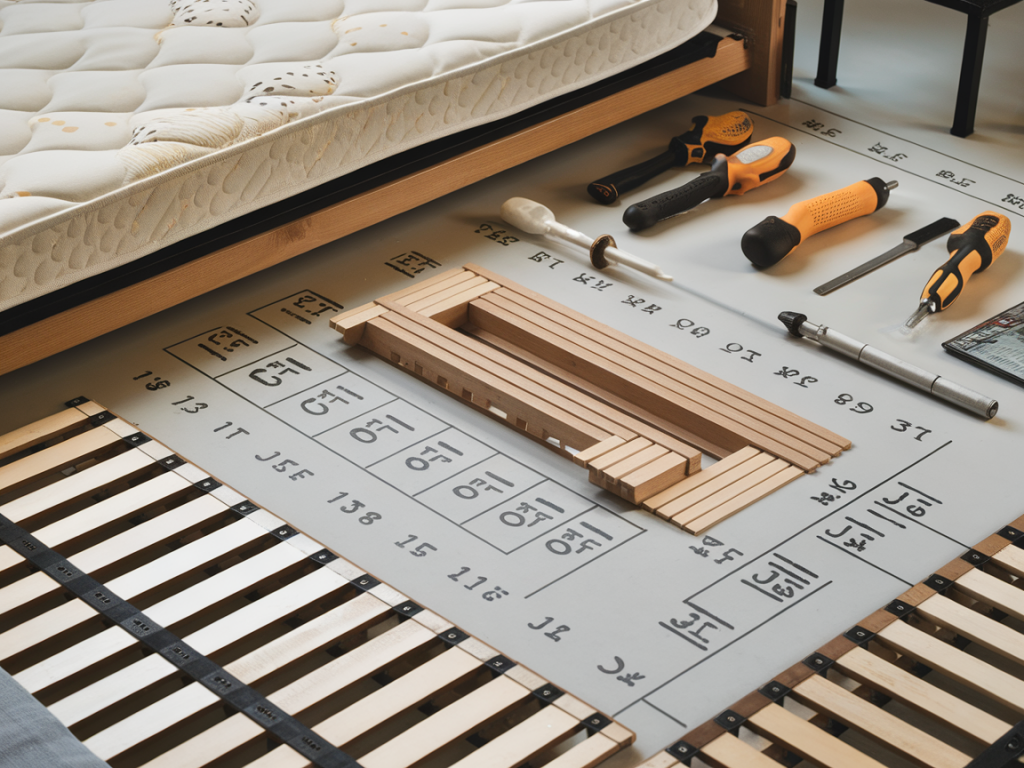
I’ve always loved making small spaces feel generous, and one project that keeps coming up in my workshops is the fabrication dun lit rabattable 140 cm. Building a robust, space-saving wall bed that fits a 140 cm mattress (typically 140×190 cm in Europe) is an incredibly satisfying DIY: it’s carpentry, engineering and interior styling rolled into one. Below I share my step-by-step technical approach, material choices, measurements, and my usual tips for making a piece that’s both durable and beautiful.
Design choices and constraints
Before sawing wood, I always set clear constraints. For a 140 cm bed I design for a mattress of 140×190 cm (sometimes 140×200 cm—check your mattress). The two main options are a vertical (hinged at the headboard/top) wall bed or a horizontal unit that folds against a long wall. I prefer the vertical version for compact rooms because the cabinet can double as shelving or a desk when closed.
Key decisions to make early:
- Orientation: vertical wall bed (my choice) vs horizontal.
- Cabinet depth: mattress thickness + frame + clearance. For a 20 cm mattress I allow ~27–32 cm internal depth; for thicker mattresses (25–30 cm) plan 35–40 cm.
- Mechanism: gas struts (recommended), torsion springs (more complex), or metal pivot hinges with counterbalance.
- Load requirements: mattress + slatted base + user weight—design for at least 250–300 kg distributed load.
Materials and hardware (cut list and specification)
I usually sketch a full cutting list. Here’s a practical material table I used recently for a vertical cabinet to house a 140×190 mattress:
| Item | Specification | Quantity |
|---|---|---|
| Plywood or MDF (cabinet carcass) | 18 mm birch plywood for strength & finish | 3–4 sheets (1220×2440 mm) |
| Front panel (bed face) | 18 mm plywood, finished on visible side | 1 (approx 150×105 cm) |
| Inner bed frame | Solid pine or hardwood, 45×45 mm or 30×50 mm | 4 rails + supports |
| Slatted base | Laminated beech slats or metal slat frame | 1 set for 140×190 |
| Gas struts | Pair sized for bed weight (check spec; often 200–350 N each) | 2 |
| Hinges and mounting brackets | Heavy-duty pivot hinges or bed-lift kit | 1 kit |
| Screws & fittings | Confirm screw lengths for 18 mm plywood and timber | Assorted |
| Finish | Primer + paint or oil + wax for plywood | As required |
Notes on hardware: choose gas struts from a reputable brand (Stabilus, Cam-Action) and work out the required force. The supplier usually asks for the weight of the moving part and its centre of gravity distance from hinge—if unsure, pick a slightly stronger strut and add mechanical stops.
Tools I use
- Circular saw or table saw (accurate sheet cutting)
- Router with straight bit (for clean edge joints and rebates)
- Drill/driver and cordless impact
- Orbit sander (120–220 grit) and sanding block
- Clamps (lots) and a workbench
- Tape measure, carpenter’s square, spirit level
Step-by-step build process
I break the build into clear stages so you can test and correct before final assembly.
1. Full-size plans and mock-up
I draw full-size elevation and side views. Then I cut a paper or cardboard template of the face panel and temporarily position it on the wall to check clearance and aesthetics—this step saves time and avoids surprises.
2. Cut carcass panels
Cut the two side panels, top and bottom shelves and back panel from 18 mm plywood. For a vertical unit: internal height = mattress length (190 cm) + clearance for mechanism (20–40 mm). Internal width = mattress width + side clearances (2×6 mm). Allow for front panel overlap if you want a framed edge.
3. Build inner bed frame
Construct a rectangle from solid timber sized to accept the slatted base. I use 45×45 mm rails with a central support. The mattress will sit on the slats fixed to this frame. Pre-drill and glue joints, reinforce with corner brackets.
4. Fit hinge points and test pivot
Attach the bed frame to the cabinet face using the pivot hinge system. Position and bolt hinges temporarily and pivot the frame to check movement and clearance. Adjust until the bed folds smoothly without rubbing the sides.
5. Install gas struts
With the bed partially open, mark strut mounting points—these are often offset from the hinge line by the supplier’s specifications. Mount brackets reliably to timber reinforcements inside the cabinet and to the bed frame. Test the opening and closing repeatedly; ensure the struts support lift and slow descent.
6. Add slatted base and mattress stops
Attach slats or a metal slat grid to the inner frame. Add foam or wooden stops at the top edge to prevent the mattress sliding when the bed is closed. Consider a small internal lip so the mattress sits flush against the cabinet face.
7. Fit handles, locks and safety catches
I fit recessed handles on the face panel to keep the silhouette tidy. Add safety catches or a simple latching mechanism to secure the bed when closed—magnetic catches can work for light use, but for heavy usage use a mechanical latch that locks the bed closed and disengages when lifted.
8. Sand, finish and seal
Sand all visible surfaces then apply primer and two coats of paint or oil. For a natural look I use a water-based hardwax oil on birch plywood. Finish both inside the cabinet and the face panel to protect from humidity.
Safety and ergonomics
There are a few non-negotiables for me:
- Always secure the cabinet to studs in the wall with heavy-duty bolts—do not rely on drywall anchors alone.
- Use gas struts with appropriate damping to avoid the bed slamming down.
- Round or chamfer exposed edges to avoid bumps.
- Make the bed easy to lift for all users—test with someone who has less upper-body strength than you.
- Label load limits and include a visible instruction plate for operation.
Styling and functional add-ons
Once structurally sound, I like to integrate small choices that elevate the piece:
- Walnut or oak edging on the face panel for warmth.
- Low-profile LED strip inside the cabinet for reading when open.
- A fold-down bedside shelf attached to the inside face that becomes a nightstand when the bed is open.
- Closed storage under the cabinet for bedding if you have headroom.
Troubleshooting common issues
If your bed rubs on the cabinet edges: check for square—use the diagonal measurement trick. If the gas struts are weak and the bed sags: replace with higher-rated struts and re-evaluate mounting points—the leverage matters. If the bed is difficult to lock closed: reposition the latch or use an adjustable strike plate so the face panel seats correctly.
I test all these steps in my own projects before recommending them—practicality and longevity matter as much as looks. If you want, I can share a downloadable cutting list and hinge-placement template tailored to a specific mattress thickness and wall type; tell me your mattress depth and wall stud spacing and I’ll draft it for you.