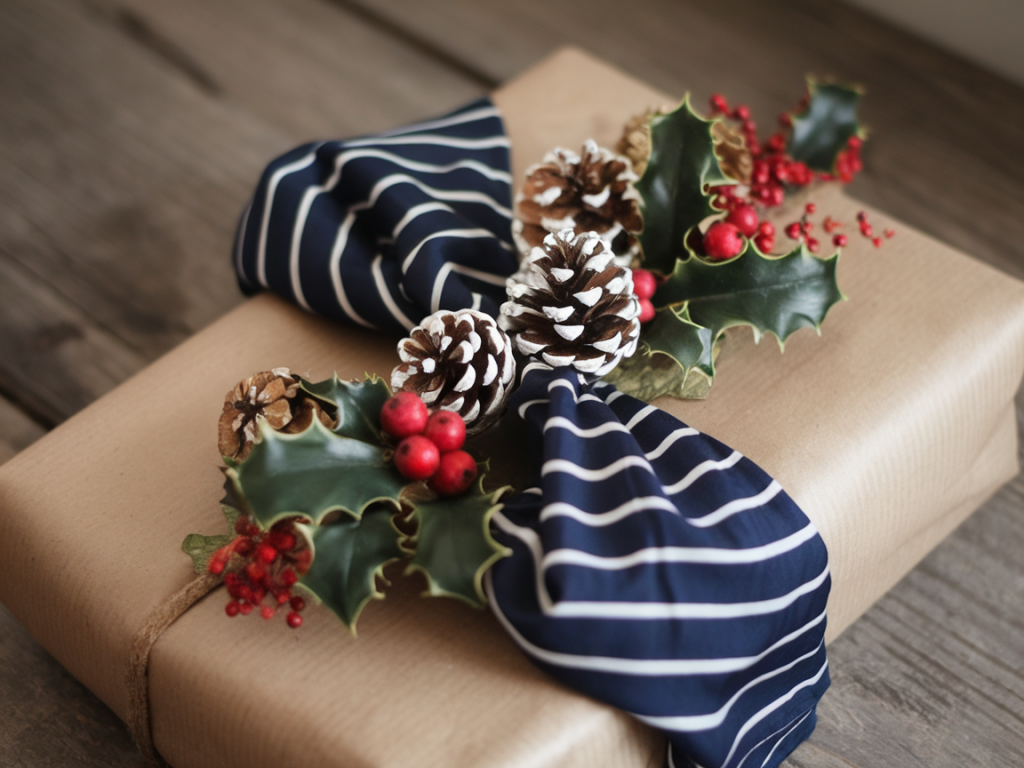
I love the ritual of gift giving — the choosing, the little note, the moment someone unwraps something that’s been selected with care. Wrapping, for me, is part of that ritual. Recently I’ve been trying to make that moment even more thoughtful by eliminating single-use wrapping paper and instead using scarves, kraft paper, and foraged decorations. Not only does this reduce waste, it creates a beautiful, tactile presentation that tells a story: the scarf can be reused, the kraft paper is recyclable, and the foraged sprig or dried flower carries a little piece of the season.
Why choose zero-waste gift wrap?
It’s simple: most glossy, metallic wrapping papers are not recyclable and end up in landfill. Choosing reusable or recyclable materials reduces waste, and it also makes your gift feel more intentional. A scarf doubles as a present and wrapping, kraft paper is widely recyclable and compostable, and natural decorations are biodegradable. When I wrap gifts this way I feel like I’m offering something that’s thoughtful from the inside out.
What you’ll need
I usually collect foraged decorations on walks — a bit of lichen-covered twig, a dried hydrangea head, or a small pinecone. If you don’t have access to wild materials, local florists or farmers’ markets often sell dried flowers inexpensively. Seeded-paper tags are a fun touch because the recipient can plant the tag afterwards.
Furoshiki basics: wrapping with scarves
Furoshiki is the Japanese art of wrapping with cloth. It’s elegant, simple, and endlessly adaptable. Here’s my favourite method for a small to medium rectangular gift (book, candle, jar):
If your scarf is long and narrow (like a silk scarf), you can roll the gift inside and tie the ends like a candy wrapper. For bulky items, a large linen throw or blanket works beautifully and becomes part of the gift.
Kraft paper + natural decorations: simple, rustic, lovely
Kraft paper is my go-to when the gift won’t benefit from a cloth wrap (for example, a set of bottles, pots, or an asymmetric object). It’s forgiving, inexpensive, and looks beautiful with a little texture added.
To make a decorative cluster, attach a small loop of twine to the sprig and tie it separately so the recipient can remove it without tearing the paper.
Styling ideas and variations
How to forage responsibly
Foraging adds beautiful natural accents, but it’s important to do so ethically. Here are my rules:
I always carry a small pair of snips and a paper bag for collecting. That way I can dry flowers or seedheads at home flat between pages or in a cool, dark cupboard so they last through the season.
Caring for cloth wrap and reusable elements
One question I get often is: “Will the item I wrapped get dirty?” Usually no — but if it does, most scarves and linen wraps can be hand-washed or machine-washed on a gentle cycle. I recommend slipping a small care note into the gift so the recipient knows the wrap is meant to be reused:
Gift tags and messaging
Handwritten notes are the best part. I like to write directly on kraft paper with a thick pencil or use a recycled-paper tag tied to the twine. For something that feels a bit special, try a seed-paper tag — the recipient can plant it and grow wildflowers.
Quick troubleshooting
Wrapping gifts in scarves, kraft paper, and foraged decorations has become a small act of mindfulness for me — a way to slow down, be creative, and honour both the person receiving the gift and the planet. It’s accessible, inexpensive, and surprisingly impactful. If you try it, I’d love to see your wraps — tag Take Root Design or send a photo via the contact page at https://www.takerootdesign.co.uk.